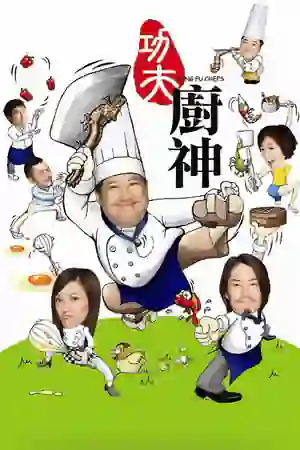
Kung Fu Chefs 2009
功夫厨神
Ousted chef Wong Bing-Yi is determined to help Shen Qing at her restaurant "Four Seas". He trains a young chef, Lung Kin-Yat to compete against Chef Tin, the head chef at "Imperial Palace", for the title of "Top Chef".
Cast


Vocabulary
Filter the words you want to study before watching.
| 汁 汁 | juice | |
| 砍 砍 | to chop; to cut down; to throw sth at sb | |
| 钥匙 鑰匙 | key | |
| 业 業 | line of business; industry; occupation; job; employment; school studies; enterprise; property; (Buddhism) karma; deed; to engage in; already | |
| 哼 哼 | to groan; to snort; to hum; to croon; humph! | |
| 淘汰 淘汰 | to wash out; (fig.) to cull; to weed out; to eliminate; to die out; to phase out | |
| 他人 他人 | another person; sb else; other people | |
| 灵魂 靈魂 | soul; spirit | |
| 恭喜 恭喜 | to congratulate; (interj.) congratulations! | |
| 制 製 | to manufacture; to make | |
| 有所 有所 | somewhat; to some extent | |
| 所谓 所謂 | so-called; what is called | |
| 丝 絲 | silk; thread; trace; (cuisine) shreds or julienne strips; classifier: a thread (of cloud, smoke etc), a bit, an iota, a hint (of sth) etc | |
| 不知 不知 | not to know; unaware; unknowingly; fig. not to admit (defeat, hardships, tiredness etc) | |
| 文 文 | language; culture; writing; formal; literary; gentle; (old) classifier for coins; Kangxi radical 67 | |
| 德 德 | Germany; German; abbr. for 德国 | |
| 情 情 | feeling; emotion; passion; situation | |
| 则 則 | (literary) (conjunction used to express contrast with a previous clause) but; then; (bound form) standard; norm; (bound form) principle; (literary) to imitate; to follow; classifier for written items | |
| 及 及 | and; to reach; up to; in time for | |
| 哦 哦 | to chant | |
| 以 㕥 | abbr. for Israel 列 | |
| 之 之 | (possessive particle, literary equivalent of 的); him; her; it | |
| 心神恍惚 心神恍惚 | perturbed (idiom) | Idiom |
| 真人不露相 真人不露相 | the sage presents as an ordinary person (idiom) | Idiom |
| 金玉满堂 金玉滿堂 | lit. gold and jade fill the hall (idiom); fig. abundant wealth; abundance of knowledge | Idiom |
| 宝刀未老 寶刀未老 | treasure knife does not age (idiom); old but still vigorous | Idiom |
| 未雨绸缪 未雨綢繆 | lit. before it rains, bind around with silk (idiom, from Book of Songs 詩經|诗经); fig. to plan ahead; to prepare for a rainy day | Idiom |
| 高招 高招 | wise move; masterstroke; bright ideas | Xiehouyu |
| 不成 不成 | won't do; unable to; (at the end of a rhetorical question) can that be? | Xiehouyu |
| 一模一样 一模一樣 | exactly the same (idiom); carbon copy; also pr. [yī mó yī yàng] | Xiehouyu |
| 同行 同行 | person of the same profession; of the same trade, occupation or industry | Xiehouyu |
| 就算 就算 | (coll.) even if | Colloquialism |
| 雷 雷 | thunder; (bound form) (military) mine, as in 雷 land mine; (coll.) to shock; to stun; to astound; (Tw) (coll.) spoiler; (Tw) (coll.) to reveal plot details to (sb) | Colloquialism |
| 嘛 嘛 | used in 吽; (Tw) (coll.) what? | Colloquialism |
| 有没有 有沒有 | (before a noun) Do (you, they etc) have ...?; Is there a ...?; (before a verb) Did (you, they etc) (verb, infinitive)?; Have (you, they etc) (verb, past participle)? | |
| 姊姊 姊姊 | older sister; Taiwan pr. [jie3 jie5] | |
| 叔公 叔公 | great uncle; grandfather's younger brother; husband's father's younger brother | |
| 招牌菜 招牌菜 | signature dish; a restaurant’s most famous dish | |
| 佛跳墙 佛跳牆 | lit. Buddha jumps over the wall, name for a Chinese dish that uses many non-vegetarian ingredients | |
| 烧焦 燒焦 | to burn; to scorch; burned; burning; scorched; charred | |
| 陈年 陳年 | (of wine) aged; (of debts etc) old; longstanding | |
| 清汤 清湯 | broth; clear soup; consommé | |
| 炒蛋 炒蛋 | scrambled eggs | |
| 鹌鹑 鵪鶉 | quail | |
| 闯祸 闖禍 | to cause an accident; to make trouble; to get into trouble | |
| 列祖列宗 列祖列宗 | one's ancestors; all the generations of forebears (idiom) | |
| 礼义廉耻 禮義廉恥 | sense of propriety, justice, integrity and honor (i.e. the four social bonds,) | |
| 国粹 國粹 | national essence; quintessence of national culture | |
| 滋补 滋補 | nourishing; nutritious | |
| 帐单 帳單 | bill; check |