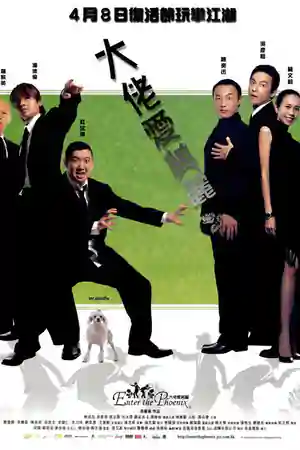
Enter the Phoenix 2004
大佬爱美丽
Georgie Hung is handsome, stylish and charming but he hides a secret that his old-fashion father, Hung who is a Triad leader, can never forgive. He has been sent to Thailand since he was a child and never returned. After Hung's death, his right-hand Cheung intends to bring back Georgie to take over. However, Cheung finds Sam, Georgie's flat-mate, whom he mistakes for Geogie...
Cast


Vocabulary
Filter the words you want to study before watching.
| 而已 而已 | that's all; nothing more | |
| 情 情 | feeling; emotion; passion; situation | |
| 以 㕥 | abbr. for Israel 列 | |
| 之 之 | (possessive particle, literary equivalent of 的); him; her; it | |
| 乘虚而入 乘虛而入 | to enter by exploiting a weak spot (idiom); to take advantage of a lapse | Idiom |
| 后生可畏 後生可畏 | the young will be redoubtable in the years to come (idiom); the younger generations will surpass us in time | Idiom |
| 先斩后奏 先斬後奏 | lit. first execute the criminal, then report it to the emperor (idiom); fig. to take some drastic action without the prior approval of higher authorities | Idiom |
| 冲锋陷阵 衝鋒陷陣 | to charge and break through enemy lines | Idiom |
| 汗马功劳 汗馬功勞 | war exploits; (fig.) heroic contribution | Idiom |
| 扭转乾坤 扭轉乾坤 | lit. to upend heaven and earth (idiom); fig. to change the course of events; to turn things around | Idiom |
| 胆小如鼠 膽小如鼠 | (idiom) chicken-hearted; gutless | Idiom |
| 自作聪明 自作聰明 | (idiom) to think oneself clever | Xiehouyu |
| 自作主张 自作主張 | (idiom) to act on one's own; to decide for oneself | Xiehouyu |
| 自讨苦吃 自討苦吃 | (idiom) to ask for trouble; to make a rod for one's own back | Xiehouyu |
| 不成 不成 | won't do; unable to; (at the end of a rhetorical question) can that be? | Xiehouyu |
| 一模一样 一模一樣 | exactly the same (idiom); carbon copy; also pr. [yī mó yī yàng] | Xiehouyu |
| 就算 就算 | (coll.) even if | Colloquialism |
| 雷 雷 | thunder; (bound form) (military) mine, as in 雷 land mine; (coll.) to shock; to stun; to astound; (Tw) (coll.) spoiler; (Tw) (coll.) to reveal plot details to (sb) | Colloquialism |
| 嘛 嘛 | used in 吽; (Tw) (coll.) what? | Colloquialism |
| 有没有 有沒有 | (before a noun) Do (you, they etc) have ...?; Is there a ...?; (before a verb) Did (you, they etc) (verb, infinitive)?; Have (you, they etc) (verb, past participle)? | |
| 爹地 爹地 | daddy (loanword) | |
| 打理 打理 | to take care of; to sort out; to manage; to put in order | |
| 洋娃娃 洋娃娃 | doll (of Western appearance) | |
| 服众 服眾 | to convince the masses | |
| 我儿 我兒 | my child | |
| 唇膏 唇膏 | lip balm; lipstick | |
| 结帐 結帳 | variant of | |
| 在天之灵 在天之靈 | soul and spirit of the deceased | |
| 冷清 冷清 | cold and cheerless; desolate; deserted | |
| 侄儿 侄兒 | nephew | |
| 孤儿寡妇 孤兒寡婦 | orphans and widows (idiom); the bereaved and helpless | |
| 太阳穴 太陽穴 | temple (on the sides of human head) | |
| 作主 作主 | to decide; to have the final say | |
| 止痛药 止痛藥 | painkiller; analgesic; anodyne | |
| 特刊 特刊 | special edition (of magazine) | |
| 扩音器 擴音器 | megaphone; loudspeaker; amplifier; microphone | |
| 撕掉 撕掉 | to tear out (and throw away); to rip away | |
| 揭穿 揭穿 | to expose; to uncover | |
| 砍死 砍死 | to hack to death; to kill with an ax | |
| 大闸蟹 大閘蟹 | Chinese mitten crab (Eriocheir sinensis); Shanghai hairy crab | |
| 伏击 伏擊 | ambush; to ambush | |
| 丧事 喪事 | funeral arrangements | |
| 吉日 吉日 | propitious day; lucky day | |
| 大嫂 大嫂 | older brother's wife; sister-in-law; elder sister (respectful appellation for an older married woman) | |
| 疏离 疏離 | to become alienated; estranged; alienation; disaffection; set wide apart | |
| 娘娘腔 娘娘腔 | sissy; effeminate | |
| 灵堂 靈堂 | mourning hall; funeral hall | |
| 一程 一程 | a journey | |
| 节哀顺变 節哀順變 | restrain your grief, accept fate (condolence phrase) | |
| 露底 露底 | to let out a secret |