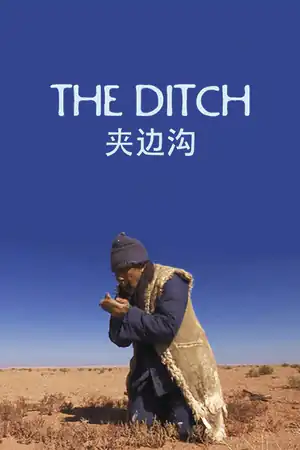
The Ditch 2011
夹边沟
The film focuses on the suffering of Chinese who were imprisoned in a forced labor camp called Jiabiangou in the Gobi Desert in winter 1960 under Mao Zedong on the grounds that they were "rightist elements". The film tells of the harsh life of these men, who coped with physical exhaustion, extreme cold, starvation and death on a daily basis.
Cast


Vocabulary
Filter the words you want to study before watching.
| 但 但 | but; yet; however; still; merely; only; just | |
| 让 讓 | to yield; to permit; to let sb do sth; to have sb do sth; to make sb (feel sad etc); by (indicates the agent in a passive clause, like 被) | |
| 啊 啊 | interjection of surprise; Ah!; Oh! | |
| 不动 不動 | motionless | Xiehouyu |
| 不客气 不客氣 | you're welcome; don't mention it; impolite; rude; blunt | Xiehouyu |
| 好看 好看 | good-looking; nice-looking; good (of a movie, book, TV show etc); embarrassed; humiliated | Xiehouyu |
| 干 乹 | dry; dried food; empty; hollow; taken in to nominal kinship; adoptive; foster; futile; in vain; (dialect) rude; blunt; (dialect) to cold-shoulder | Xiehouyu |
| 吃的 吃的 | (coll.) food | Colloquialism |
| 这不 這不 | (coll.) As a matter of fact,... (used to introduce evidence for what one has just asserted) | Colloquialism |
| 看看 看看 | to take a look at; to examine; to survey; (coll.) pretty soon | Colloquialism |
| 一块 一塊 | a piece; a chunk; (fig.) (coll.) (typically preceded by a specifier such as) aspect; area; dimension (Example: "the emotional aspect (of it)"); (coll.) one yuan; a dollar; together; in the same | Colloquialism |
| 不会 不會 | improbable; unlikely; will not (act, happen etc); not able; not having learned to do sth; (coll.) (Tw) don't mention it; not at all | Colloquialism |
| 明儿个 明兒個 | (coll.) tomorrow | Colloquialism |
| 真是 真是 | indeed; truly; (coll.) (used to express disapproval, annoyance etc) | Colloquialism |
| 菜 菜 | dish (type of food); vegetable; cuisine; (coll.) (one's) type; (of one's skills etc) weak; poor | Colloquialism |
| 肉 肉 | meat; flesh; pulp (of a fruit); (coll.) (of a fruit) squashy; (of a person) flabby; irresolute; Kangxi radical 130 | Colloquialism |
| 吗 嗎 | (coll.) what? | Colloquialism |
| 那 那 | (specifier) that; the; those (colloquial pr. [nèi]); (pronoun) that (referring to persons, things or situations); then (in that case) | Colloquialism |
| 上海 上海 | Shanghai municipality | Proper Noun |
| 明水 明水 | Mingshui county in Suihua 綏化|绥化, Heilongjiang | Proper Noun |
| 老子 老子 | Laozi or Lao-tze (c. 500 BC), Chinese philosopher, the founder of Taoism; the sacred book of Daoism, by Laozi | Proper Noun |
| 元山 元山 | Wonsan city in Kangweon province 江原道 of North Korea | Proper Noun |
| 大西 大西 | Ōnishi (Japanese surname) | Proper Noun |
| 山水 山水 | Sansui, Japanese company | Proper Noun |
| 远东 遠東 | Far East (loanword) | Proper Noun |
| 这个 這個 | (pronoun) this; (adjective) this | |
| 不是 不是 | no; is not; not | |
| 明 明 | bright, light, brilliant; clear | |
| 一个 一個 | a; an; one; the whole (afternoon, summer vacation etc) | |
| 这是 這是 | this is; this is the ... | |
| 快点 快點 | to do sth more quickly; Hurry up!; Get a move on! | |
| 找不到 找不到 | can't find | |
| 一下 一下 | (after a verb) a bit; a little (indicating brief duration, or softening the tone, or suggesting giving sth a try); all at once; suddenly | |
| 不了 不了 | no thanks (used to politely but informally decline) | |
| 其它 其它 | (adjective) other | |
| 不能 不能 | cannot; must not; should not | |
| 一点 一點 | a bit; a little bit; (used in negative expressions) (not) the least bit; (after an adjective, used to form the comparative) a bit more, -er; a point (in a discussion etc); (calligraphy) dot stroke (、); one o'clock (abbr. for 一點鍾|一点钟[yi1 dia | |
| 几个 幾個 | a few; several; how many | |
| 吃人 吃人 | exploitative; oppressive | |
| 汉 漢 | Chinese people; Chinese language | |
| 着呢 著呢 | comes at the end of the sentence to indicate a strong degree; quite; rather | |
| 那个 那個 | that one; that thing; that (as opposed to this); (used before a verb or adjective for emphasis); (used to humorously or indirectly refer to sth embarrassing, funny etc, or when one can't think of the right word); (used in speech as a filler | |
| 在地 在地 | (Tw) local; native (from Taiwanese 在地, Tai-lo pr. [tsāi-tē]) | |
| 几天 幾天 | several days | |
| 病号 病號 | sick personnel; person on the sick list; patient | |
| 分子 分子 | (chemistry) molecule; (math) numerator of a fraction | |
| 不在 不在 | not to be present; to be out; (euphemism) to pass away; to be deceased | |
| 他妈的 他媽的 | (taboo curse) damn it!; fucking | |
| 记事 記事 | to keep a record of events; record; to start to form memories (after one's infancy) | |
| 没有什么 沒有什麼 | it is nothing; there's nothing... about it |