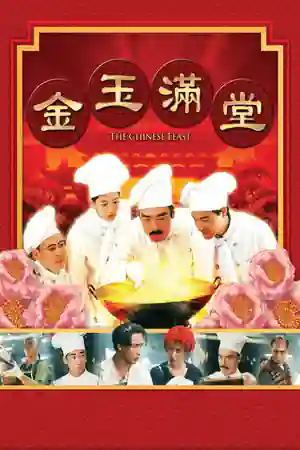
The Chinese Feast 1995
金玉满堂
Within a few years, petty crook Chiu rises to gang leader. But his professional ambitions are actually quite different: he wants to leave illegality behind and make a career for himself and his lover in Canada... as a chef. However, this craft must first be learned and Chiu's talent in the field of cooking leaves much to be desired.
Vocabulary
Filter the words you want to study before watching.
| 总 總 | general; overall; to sum up; in every case; always; invariably; anyway; after all; eventually; sooner or later; surely; (after a person's name) abbr. for 总经理 or 总编 etc | |
| 内 內 | inside; inner; internal; within; interior | |
| 关系 關係 | relation; relationship; to concern; to affect; to have to do with; guanxi | |
| 张 張 | to open up; to spread; sheet of paper; classifier for flat objects, sheet; classifier for votes | |
| 已 已 | already; to stop; then; afterwards | |
| 心 心 | heart; mind; intention; center; core | |
| 继续 繼續 | to continue; to proceed with; to go on with | |
| 比赛 比賽 | competition (sports etc); match; to compete | |
| 世界 世界 | world | |
| 只是 只是 | merely; only; just; nothing but; simply; but; however | |
| 为了 為了 | for; for the purpose of; in order to | |
| 希望 希望 | to hope; a hope; a wish | |
| 种 種 | seed; species; kind; type; classifier for types, kinds, sorts | |
| 死 死 | to die; impassable; uncrossable; inflexible; rigid; extremely; damned | |
| 所 所 | actually; place; classifier for houses, small buildings, institutions etc; that which; particle introducing a relative clause or passive | |
| 开始 開始 | to begin; beginning; to start; initial | |
| 时 時 | o'clock; time; when; hour; season; period | |
| 就是 就是 | exactly; precisely; only; simply; just; (used correlatively with 也) even; even if | |
| 被 被 | quilt; to cover (with); (literary) to suffer (a misfortune); used to indicate passive voice (placed before the doer of the action like "by" in English passive-voice sentences, or, if the doer is not mentioned, before the verb); (since c. 2009) (sarcastic or jocular) used to indicate that the following word should be regarded as being in air quotes (as in 被旅游 to "go on a trip", for example) | |
| 把 把 | to hold; to grasp; to hold a baby in position to help it urinate or defecate; handlebar; classifier: handful, bundle, bunch; classifier for things with handles; (used to put the object before the verb: 把 + {noun} + {verb}) | |
| 说三道四 說三道四 | to make thoughtless remarks (idiom); to criticize; gossip | Idiom |
| 改行 改行 | to change profession | Xiehouyu |
| 下流 下流 | lower course of a river; low-class; mean and lowly; vulgar; obscene | Xiehouyu |
| 开心 開心 | to feel happy; to rejoice; to have a great time; to make fun of sb | Xiehouyu |
| 够 夠 | enough (sufficient); enough (too much); (coll.) (before adj.) really; (coll.) to reach by stretching out | Colloquialism |
| 拉 拉 | to pull; to play (a bowed instrument); to drag; to draw; to chat; (coll.) to empty one's bowels | Colloquialism |
| 满汉 滿漢 | Manchurian-Chinese (relations) | Proper Noun |
| 天津 天津 | Tianjin municipality | Proper Noun |
| 三藩市 三藩市 | San Francisco (California) | Proper Noun |
| 深圳 深圳 | Shenzhen, sub-provincial city in Guangdong Province | Proper Noun |
| 四川 四川 | Sichuan Province, capital Chengdu | Proper Noun |
| 满人 滿人 | a Manchu | Proper Noun |
| 泰国 泰國 | Thailand | Proper Noun |
| 大雪 大雪 | Daxue or Great Snow, 21st of the 24 solar terms 二十四節氣|二十四节气 7th-21st December | Proper Noun |
| 见过 見過 | seen | |
| 象 象 | elephant; ivory; figure, image | |
| 满分 滿分 | full marks | |
| 一定要 一定要 | must | |
| 欧 歐 | translit.: Europe; ohm; surname | |
| 今晚 今晚 | tonight | |
| 十万 十萬 | hundred thousand | |
| 不怕 不怕 | fearless; not worried (by setbacks or difficulties); even if; even though | |
| 身 身 | body; trunk, hull; rad. no. 158 | |
| 放生 放生 | to set free a captive animal (in some cases, as an act of Buddhist mercy) | |
| 息 息 | rest, put stop to, end, cease | |
| 别客气 別客氣 | don't mention it; no formalities, please | |
| 接住 接住 | to catch (sth thrown etc); to receive (sth given); to accept | |
| 八角 八角 | anise; star anise; aniseed; octagonal; Fructus Anisi stellati | |
| 平手 平手 | (sports) draw; tie | |
| 黄鱼 黃魚 | yellow croaker (fish) |