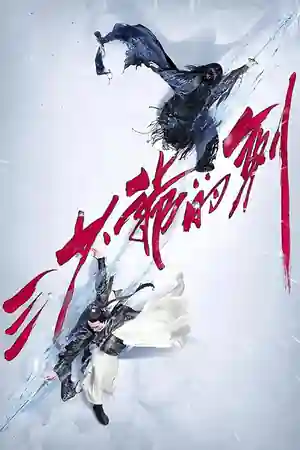
Sword Master 2016
三少爷的剑
Weary of the bloodshed and violence from the martial arts world, a powerful swordsman banishes himself to the humble life a vagrant, wandering the fringes of society. But his violent past refuses to let him go quietly. The master swordsman must regain the ability to wield his sword and fight those disrupting the peace he so desperately craves.
Cast


Vocabulary
Filter the words you want to study before watching.
| 还 還 | still; still in progress; still more; yet; even more; in addition; fairly; passably (good); as early as; even; also; else | |
| 很 很 | (adverb of degree); quite; very; awfully | |
| 来 來 | to come; (used as a substitute for a more specific verb); hither (directional complement for motion toward the speaker, as in 回来); ever since (as in 自古以来); for the past (amount of time); (prefix) the coming ...; the next ... (as in 来世); (between two verbs) in order to; (after a round number) approximately; (used after 得 to indicate possibility, as in 谈得来, or after 不 to indicate impossibility, as in 吃不来) | |
| 上 上 | (bound form) up; upper; above; previous; first (of multiple parts); to climb; to get onto; to go up; to attend (class or university); (directional complement) up; (noun suffix) on; above | |
| 到 到 | to reach; to arrive; to leave for; to go to; to (a place); until (a time); up to (a point); (verb complement indicating arriving at a place or reaching a point); considerate; thoughtful; thorough | |
| 对 對 | right; correct; towards; at; for; concerning; regarding; to treat (sb a certain way); to face; (bound form) opposite; facing; matching; to match together; to adjust; to fit; to suit; to answer; to reply; to add; to pour in (a fluid); to check; to compare; classifier: couple; pair | |
| 都 都 | all; both; entirely; (used for emphasis) even; already; (not) at all | |
| 也 也 | (adverb) also; both ... and ... (before predicates only); (literary) particle having functions similar to 啊 | |
| 会 會 | to balance an account; accounting; accountant | |
| 一 一 | one; single; a (article); as soon as; entire; whole; all; throughout; "one" radical in Chinese characters (Kangxi radical 1); also pr. [yāo] for greater clarity when spelling out numbers digit by digit | |
| 好 好 | to be fond of; to have a tendency to; to be prone to | |
| 我们 我們 | we; us; ourselves; our | |
| 要 要 | (bound form) to demand; to coerce | |
| 人 人 | person; people | |
| 个 個 | used in 自个儿 | |
| 说 說 | to persuade | |
| 和 咊 | (joining two nouns) and; together with; with (Taiwan pr. [hàn]); (math.) sum; to make peace; (sports) to draw; to tie; (bound form) harmonious; (bound form) Japan; Japanese | |
| 就 就 | (after a suppositional clause) in that case; then; (after a clause of action) as soon as; immediately after; (same as 是) merely; nothing else but; simply; just; precisely; exactly; only; as little as; as much as; as many as; to approach; to move towards; to undertake; to engage in; (often followed by 着) taking advantage of; (of food) to go with; with regard to; concerning; (pattern: 就 ... 也 ...) even if ... still ...; (pattern: 不 ... 就 ...) if not ... then must be ... | |
| 这 這 | (pronoun) this; these; (bound form) this; the (followed by a noun); (bound form) this; these (followed by a classifier) (in this sense, commonly pr. [zhèi], esp. in Beijing) | |
| 他 他 | he; him (used for either sex when the sex is unknown or unimportant); (used before sb's name for emphasis); (used as a meaningless mock object); (literary) other | |
| 不 不 | no; not so; (bound form) not; un- | |
| 有 有 | to have; there is; (bound form) having; with; -ful; -ed; -al (as in 意 intentional) | |
| 你 你 | you (informal, as opposed to courteous 您) | |
| 在 在 | to exist; to be alive; (of sb or sth) to be (located) at; (used before a verb to indicate an action in progress) | |
| 是 是 | to be (followed by substantives only); correct; right; true; (respectful acknowledgement of a command) very well; (adverb for emphatic assertion) | |
| 我 我 | I; me; my | |
| 了 了 | (completed action marker); (modal particle indicating change of state, situation now); (modal particle intensifying preceding clause) | |
| 的 的 | of; ~'s (possessive particle); (used after an attribute); (used to form a nominal expression); (used at the end of a declarative sentence for emphasis); also pr. [dì] or [di] in poetry and songs | |
| 阿 阿 | abbr. for country names that begin with: Algeria, Afghanistan etc | Interjection |
| 嘞 嘞 | (Cant.) final particle used for polite refusal | Interjection |