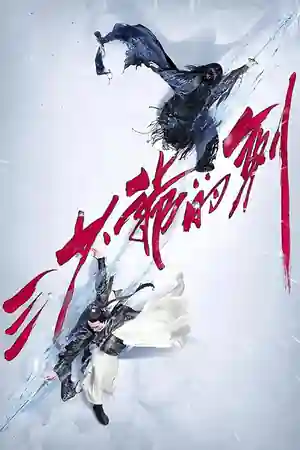
Sword Master 2016
三少爷的剑
Weary of the bloodshed and violence from the martial arts world, a powerful swordsman banishes himself to the humble life a vagrant, wandering the fringes of society. But his violent past refuses to let him go quietly. The master swordsman must regain the ability to wield his sword and fight those disrupting the peace he so desperately craves.
Cast


Vocabulary
Filter the words you want to study before watching.
| 肉 肉 | meat; flesh; pulp (of a fruit); (coll.) (of a fruit) squashy; (of a person) flabby; irresolute; Kangxi radical 130 | Colloquialism |
| 山 山 | mountain; hill; (coll.) small bundle of straw for silkworms to spin cocoons on | Colloquialism |
| 块 塊 | lump; chunk; piece; classifier for pieces of cloth, cake, soap etc; (coll.) classifier for money and currency units | Colloquialism |
| 花 花 | flower; blossom; fancy pattern; florid; to spend (money, time); (coll.) lecherous; lustful | Colloquialism |
| 吗 嗎 | (coll.) what? | Colloquialism |
| 那 那 | (specifier) that; the; those (colloquial pr. [nèi]); (pronoun) that (referring to persons, things or situations); then (in that case) | Colloquialism |
| 七星 七星 | Qixing district of Guilin city, Guangxi | Proper Noun |
| 南山 南山 | Nanshan or Namsan, common place name; Nanshan district of Shenzhen City 深圳市, Guangdong | Proper Noun |
| 老子 老子 | Laozi or Lao-tze (c. 500 BC), Chinese philosopher, the founder of Taoism; the sacred book of Daoism, by Laozi | Proper Noun |
| 谁知道 誰知道 | God knows...; Who would have imagined...? | |
| 十三 十三 | thirteen; 13 | |
| 这个 這個 | (pronoun) this; (adjective) this | |
| 一个 一個 | a; an; one; the whole (afternoon, summer vacation etc) | |
| 不能 不能 | cannot; must not; should not | |
| 不了 不了 | no thanks (used to politely but informally decline) | |
| 那个 那個 | that one; that thing; that (as opposed to this); (used before a verb or adjective for emphasis); (used to humorously or indirectly refer to sth embarrassing, funny etc, or when one can't think of the right word); (used in speech as a filler | |
| 不是 不是 | no; is not; not | |
| 不想 不想 | unexpectedly; to one's surprise | |
| 一次 一次 | first; first time; once; (math.) linear (of degree one) | |
| 我去 我去 | (slang) what the...!; oh my god!; that's insane! | |
| 这是 這是 | this is; this is the ... | |
| 儿 兒 | son, child; KangXi radical 10 | |
| 没事 沒事 | it's not important; it's nothing; never mind; to have nothing to do; to be free; to be all right (out of danger or trouble) | |
| 说出 說出 | to speak out; to declare (one's view) | |
| 那天 那天 | that day; the other day | |
| 不好 不好 | no good | |
| 太好了 太好了 | very good | |
| 一点 一點 | a bit; a little bit; (used in negative expressions) (not) the least bit; (after an adjective, used to form the comparative) a bit more, -er; a point (in a discussion etc); (calligraphy) dot stroke (、); one o'clock (abbr. for 一點鍾|一点钟[yi1 dia | |
| 一下 一下 | (after a verb) a bit; a little (indicating brief duration, or softening the tone, or suggesting giving sth a try); all at once; suddenly | |
| 怎么了 怎麼了 | What's up?; What's going on?; What happened? | |
| 小子 小子 | (literary) youngster; (old) young fellow (term of address used by the older generation); (old) I, me (used in speaking to one's elders) | |
| 人中 人中 | philtrum; infranasal depression; the "human center" acupuncture point | |
| 放开 放開 | to let go; to release | |
| 今 今 | now, today, modern era | |
| 拿下 拿下 | to arrest; to capture; to seize; to win (a set, a game etc) | |
| 在下 在下 | under; myself (humble) | |
| 我等 我等 | we; us (archaic) | |
| 婢女 婢女 | slave girl; servant girl | |
| 住手 住手 | to desist; to stop; to stay one's hand | |
| 不在 不在 | not to be present; to be out; (euphemism) to pass away; to be deceased | |
| 禅师 禪師 | honorific title for a Buddhist monk | |
| 医 醫 | cure, heal; doctor, medical | |
| 等一下 等一下 | to wait a moment; later; in awhile | |
| 从来没 從來沒 | have never; has never | |
| 几个 幾個 | a few; several; how many | |
| 人人 人人 | everyone; every person | |
| 是的 是的 | yes, that's right; variant of | |
| 不可以 不可以 | may not | |
| 家的 家的 | (old) wife | |
| 十九 十九 | nineteen; 19 |