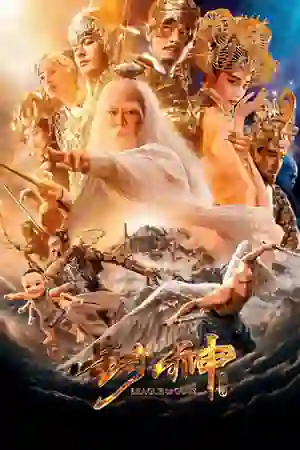
League of Gods 2016
封神传奇
During the reign of King Zhou, an official enters his bedchamber, and is devoured by the monstrous tails of Daji, his concubine. Outside their city, several warriors within a metal wagon discuss their strategies to free the Invisible People and their Chief, when Jiang Ziya appears to them. He tells them that when King Zhou was younger, he let himself become possessed by the Black Dragon for his quest for power.
Cast


Vocabulary
Filter the words you want to study before watching.
| 厉害 厲害 | (used to describe sb or sth that makes a very strong impression, whether favorable or unfavorable) terrible; intense; severe; devastating; amazing; awesome; outstanding; (of a person) stern; strict; harsh; shrewd; tough; (of an animal) fierce; (of a resemblance) striking; (of liquor or chili pepper) strong; (of bacteria) virulent | |
| 聪明 聰明 | intelligent; clever; bright; smart; acute (of sight and hearing) | |
| 剩下 剩下 | to remain; to be left over | |
| 记忆 記憶 | to remember; to recall; memory | |
| 掌握 掌握 | to grasp (often fig.); to control; to seize (initiative, opportunity, destiny); to master; to know well; to understand sth well and know how to use it; fluency | |
| 偷 偷 | to steal; to pilfer; to snatch; thief; stealthily | |
| 之中 之中 | inside; among; in the midst of (doing sth); during | |
| 鬼 鬼 | disembodied spirit; ghost; devil; (suffix) person with a certain vice or addiction etc; sly; crafty; resourceful (variant of 诡); one of the 28 constellations of ancient Chinese astronomy | |
| 疯 瘋 | insane; mad; wild | |
| 颗 顆 | classifier for small spheres, pearls, corn grains, teeth, hearts, satellites etc | |
| 傻 傻 | foolish | |
| 抢 搶 | (literary) to knock against (esp. to knock one's head on the ground in grief or rage); opposite in direction; contrary | |
| 居然 居然 | unexpectedly; to one's surprise; go so far as to | |
| 陪 陪 | to accompany; to keep sb company; to assist; old variant of 赔 | |
| 放弃 放棄 | to renounce; to abandon; to give up | |
| 再次 再次 | one more time; again; one more; once again | |
| 神 神 | God; abbr. for 舟 | |
| 拥有 擁有 | to have; to possess | |
| 控制 控制 | to control | |
| 杀 殺 | to kill; to murder; to attack; to weaken or reduce; to smart (dialect); (used after a verb) extremely | |
| 肯定 肯定 | to be certain; to be positive; assuredly; definitely; to give recognition; to affirm; affirmative (answer) | |
| 如此 如此 | like this; so; such | |
| 唯一 唯一 | only; sole | |
| 将 將 | will; shall; to use; to take; to checkmate; just a short while ago; (introduces object of main verb, used in the same way as 把) | |
| 可 可 | (prefix) can; may; able to; -able; to approve; to permit; to suit; (particle used for emphasis) certainly; very | |
| 自不量力 自不量力 | to overestimate one's capabilities (idiom) | Idiom |
| 一言为定 一言為定 | (idiom) it's a deal; that's settled then | Idiom |
| 斗转星移 斗轉星移 | lit. the Big Dipper has turned and the stars have moved; time flies; also written | Idiom |
| 刚愎自用 剛愎自用 | obstinate and self-opinionated (idiom) | Idiom |
| 流离失所 流離失所 | destitute and homeless (idiom); forced from one's home and wandering about; displaced | Idiom |
| 兵临城下 兵臨城下 | soldiers at the city walls (idiom); fig. at a critical juncture | Idiom |
| 无法 無法 | unable; incapable | Xiehouyu |
| 尾巴 尾巴 | tail; colloquial pr. [yǐ ba] | Colloquialism |
| 烧 燒 | to burn; to cook; to stew; to bake; to roast; to heat; to boil (tea, water etc); fever; to run a temperature; (coll.) to let things go to one's head | Colloquialism |
| 帅 帥 | (bound form) commander-in-chief; (bound form) to lead; to command; handsome; graceful; dashing; elegant; (coll.) cool!; sweet!; (Chinese chess) general (on the red side, equivalent to a king in Western chess) | Colloquialism |
| 俩 倆 | two (colloquial equivalent of 两个); both; some | Colloquialism |
| 抱 抱 | to hold; to carry (in one's arms); to hug; to embrace; to surround; to cherish; (coll.) (of clothes) to fit nicely | Colloquialism |
| 姜子牙 姜子牙 | Jiang Ziya (c. 1100 BC, dates of birth and death unknown), partly mythical sage advisor to King Wen of Zhou and purported author of “Six Secret Strategic Teachings”, one of the Seven Military Classics | Proper Noun |
| 北斗 北斗 | Great Bear; Big Dipper; Beidou or Peitou Town in Changhua County, Taiwan | Proper Noun |
| 九州 九州 | division of China during earliest dynasties; fig. ancient China; Kyūshū, southernmost of Japan's four major islands | Proper Noun |
| 一战 一戰 | World War I (1914-1918) | Proper Noun |
| 风火轮 風火輪 | (martial arts) wind-and-fire wheel, weapon used in hand-to-hand fighting; (Daoism) a magical pair of wheels on which one can stand to ride at great speed, used by Nezha; (fig.) never-ending treadmill | |
| 姬 姬 | beauty; imperial concubine | |
| 族人 族人 | clansman; clan members; relatives; ethnic minority | |
| 尾 尾 | tail, extremity; end, stern | |
| 大王 大王 | king; magnate; person having expert skill in something | |
| 怎么会 怎麼會 | how could it | |
| 日落 日落 | sundown; sunset | |
| 可不 可不 | that's just the way it is; exactly! | |
| 降世 降世 | lit. to descend to earth (of an immortal); to be born |