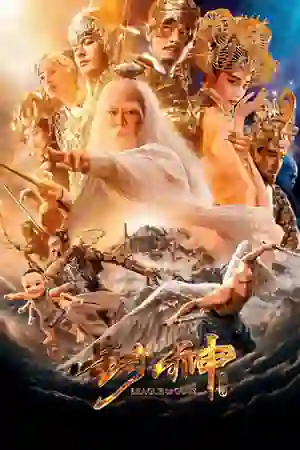
League of Gods 2016
封神传奇
During the reign of King Zhou, an official enters his bedchamber, and is devoured by the monstrous tails of Daji, his concubine. Outside their city, several warriors within a metal wagon discuss their strategies to free the Invisible People and their Chief, when Jiang Ziya appears to them. He tells them that when King Zhou was younger, he let himself become possessed by the Black Dragon for his quest for power.
Cast


Vocabulary
Filter the words you want to study before watching.
| 把 把 | to hold; to grasp; to hold a baby in position to help it urinate or defecate; handlebar; classifier: handful, bundle, bunch; classifier for things with handles; (used to put the object before the verb: 把 + {noun} + {verb}) | |
| 风吹草动 風吹草動 | lit. grass stirring in the wind (idiom); fig. the slightest whiff of trouble | Idiom |
| 假的 假的 | bogus; ersatz; fake; mock; phony | Xiehouyu |
| 开心 開心 | to feel happy; to rejoice; to have a great time; to make fun of sb | Xiehouyu |
| 星星 星星 | (coll.) a star; the stars in the sky | Colloquialism |
| 够 夠 | enough (sufficient); enough (too much); (coll.) (before adj.) really; (coll.) to reach by stretching out | Colloquialism |
| 拉 拉 | to pull; to play (a bowed instrument); to drag; to draw; to chat; (coll.) to empty one's bowels | Colloquialism |
| 东海 東海 | East China Sea; East Sea (Chinese mythology and ancient geography) | Proper Noun |
| 长毛 長毛 | (derog.) the Longhairs (Taiping rebels of the 19th century) | Proper Noun |
| 见过 見過 | seen | |
| 长老 長老 | elder; term of respect for a Buddhist monk | |
| 一只 一隻 | one (measure word for animals, boats, certain objects); a single ... | |
| 术 術 | art, skill, special feat; method, technique | |
| 一定要 一定要 | must | |
| 知道了 知道了 | OK!; Got it! | |
| 战 戰 | war, fighting, battle | |
| 分头 分頭 | separately; severally; parted hair | |
| 不怕 不怕 | fearless; not worried (by setbacks or difficulties); even if; even though | |
| 老头 老頭 | old fellow; old man; father; husband | |
| 什么地方 什麼地方 | somewhere; someplace; where | |
| 带回 帶回 | to bring back | |
| 所有人 所有人 | everyone; owner | |
| 身 身 | body; trunk, hull; rad. no. 158 | |
| 天亮 天亮 | to grow light (at daybreak) | |
| 千年 千年 | millennium | |
| 每次 每次 | every time | |
| 肉身 肉身 | corporeal body | |
| 交出 交出 | to hand over | |
| 闻到 聞到 | to smell; to sniff sth out; to perceive by smelling | |
| 道行 道行 | skills acquired through religious practice; (fig.) ability; skill; Taiwan pr. [dao4 hang5] | |
| 世 世 | generation; world; era | |
| 呈 呈 | submit, show; appear; petition | |
| 换班 換班 | to change shift; the next work shift; to relieve (a workman on the previous shift); to take over the job | |
| 不可能 不可能 | impossible; cannot; not able | |
| 带走 帶走 | to carry; to take away | |
| 带孩子 帶孩子 | to look after a baby; to take care of a young child | |
| 水道 水道 | watercourse (river, canal, drain etc); water route; lane (in a swimming pool) | |
| 备 備 | prepare, ready, perfect | |
| 生路 生路 | a way to make a living; a way to survive; a way out of a predicament | |
| 进发 進發 | (of a group of people or a convoy of vehicles) to set off | |
| 令人 令人 | to cause one (to do sth); to make one (angry, delighted etc) | |
| 动气 動氣 | to get angry | |
| 得看 得看 | (it) depends on... | |
| 重生 重生 | to be reborn; rebirth | |
| 小孩子 小孩子 | child | |
| 物 物 | thing, substance, creature | |
| 又来了 又來了 | Here we go again. | |
| 玩意 玩意 | toy; plaything; thing; act; trick (in a performance, stage show, acrobatics etc) | |
| 成了 成了 | to be done; to be ready; that's enough!; that will do! | |
| 无我 無我 | anatta (Buddhist concept of "non-self") |